Showing posts with label Lake Michigan. Show all posts

Sunday, January 15, 2017

Duck Watching Along Mighty Lake Michigan


It was time to do a bit of bird watching; winter cold, or no winter cold.  Fellow birder Robert Massey had a free Saturday morning too (Barbara was working) so the two of us jumped in the "IBIRD" SPT (silver pick-up truck) at around 8:00 AM and headed to Milwaukee's east side.  At Robert's home along the Menominee River Parkway; a woman has fed the Mallards for years.  Because of timing, I was able to witness their early morning waddle-march from the north to the south across the road.

They would bunch-up at the edge and then flow across in a straight line to her driveway; heading for the backyard to where the feed was supposedly located.  How many days, weeks, years these ducks and their offspring had been doing this is unknown to me.  Whether there was even any food for them when they got there was also a mystery; but some "pull" was making them attempt that practiced journey day after day, week after week, year after year.

The weather was cooperating with a mild 23 degrees and virtually no wind as we stepped out of the truck at the Linwood water treatment plant for our first of six looks. Canada geese were already present on the grass along the banks of the Lake Michigan shoreline.  The snow was mostly gone due to the recent mild weather that had included actual rain.  This meant that they could easily crop at the grass to fill their bellies with what they needed to sustain themselves.


Dozens of their cousins, sisters, brothers, etc. also swam in the frigid water of the great lake just off

shore.  Along with these common residents and visitors to Lake Michigan were some species that only seen to over-winter here; Buffleheads, Common goldeneye, Lesser and Greater scaups and Red-breasted and Common merganser.  As we would discover in the several stops we would make; the Buffleheads seemed to prefer the northernmost shoreline and could not be seen as we ventured southward.

From Audubon.org, "A diminutive diver, one of our smallest ducks, often very energetic in its feeding. Related to the goldeneyes and, like them, nests in cavities; but unlike other hole-nesting ducks, the Bufflehead is small enough to use unmodified old nest holes of Northern Flickers, giving it a ready source of good nest sites. Less sociable than most ducks, seen in pairs or small groups, almost never in large flocks. Takes wing easily from the water, flies with rapid wing beats. The name "Bufflehead" is derived from "buffalo-head," for the male's odd puffy head shape."


One of our most memorable (audible) moments was when we walked across the frozen goose-poop
littered grass from the parking lot at McKinley marina to the water's edge.  As we neared the sidewalk that runs along the lakeshore boundary, we unwittingly scared dozens of goldeneye that were (previously unseen) huddled against the rocks and the 12 foot drop from above to below.  They all suddenly skedaddled eastward just above the water's surface making a gloriously loud whining noise with their rapid wing beats to escape the interlopers to their quiet morning paddling.

Joggers and people with their dogs were out in force as we stood at each place with our scope and binoculars.  One of the most interesting discoveries to me was to see the many ice-fishing enthusiasts that were enjoying their Saturday on the frozen water of the Lakeshore State Park lagoon.  This proximity between angler and the buildings of downtown Milwaukee was both surreal and fascinating to me. Who would have thought that these two vastly different scenarios could co-exist; bustling urban life and serene outdoor sportfishing?

In all we stopped along Linwood,  Lakeshore drive at Bradford Beach, McKinley Marina, Lakeshore State Park, the area under the Hoan bridge carved out for the Milwaukee smelting community and the old Coast Guard impound lot and the famous, ever-present but badly deteriorated blue trailer.  Our final stop for the morning was to view the hundreds of the same species we had been seeing that had congregated at the breakwall just south of the Lake Express Ferry.  All in all we saw hundreds and hundreds of birds in just a few hours time that seemingly thrive in the ice-cold waters of our great lake.  C'mon out and play on a winter's morning...plenty of others are and having a great time!

Robert Massey with the spotting scope

Bufflehead
Lone Black duck on the ice
Goldeneye walking on water?

Our Species List:


  1. Red-breasted merganser
  2. Common merganser
  3. Mallard
  4. Greater Scaup
  5. Lesser Scaup
  6. American Crow
  7. Herring gull
  8. Black-backed gull
  9. Ring-billed gull
  10. Black duck
  11. Bufflehead
  12. Common goldeneye


Saturday, February 7, 2015

Lake Michigan Duck Watch - 2015

View from the WPT

On a sub-zero day in January 2015, I drove the WPT east to the shores of bone-chilling Lake Michigan to see just what ducks were there.  It was overcast, gray and windy as I pulled up in the parking lot of the water station and strapped on my gear.  I was dressed in layers to help fight the cold, but my hands were having a tough time with the gloves I had chosen.  Mittens would have been smarter; but using a camera with no finger dexterity is difficult.  I waded through a freshly falled amount of powder and approached the lake.  Ice had formed to within 10 yards of the shore in chaotically layered islands.  A slow but determined wave motion sloshed up into small "bays" and cuts in the ice pack.  I needed to be extremely careful not to slip; but even more wary not to blunder into a disguised mini-gorge and into the ice water. There was virtually no one who would ever hear any pleas for help.  The only other person I saw was one of those psycho-runners tip-toeing on the icy public sidewalk near Lakeshore Drive...and I thought I was nuts.

Ooh boy it's cold!
The predominant avian form seen this day was the Common goldeneye.  1. "Among Common Goldeneyes pair formation begins in midwinter, and until then the two sexes often form separate flocks. Indeed, males winter farther north than do the females. During its courtship display, the male stretches his head forward along the water and then snaps it rapidly upward over his back, bill pointed skyward, while uttering a shrill, two-noted call. Then he swings his orange feet forward, sending up a small shower in front of him. The wings of this species produce a loud whistling sound in flight, easily identified even when the birds cannot be seen; hunters call this species the "Whistler." Goldeneyes can dive to depths of 20 feet (6 meters) or more, but generally limit themselves to about 10 feet (3 meters). In winter, goldeneyes feed mainly on mollusks; in summer, their diet shifts to aquatic plants and insects.


Common Goldeneye
This species is particularly hardy and often the last waterfowl species to leave the breeding grounds and the first to return. Migration peaks occur in November and March/April. The species migrates in small, loose flocks, concentrating at suitable stopover points, especially in spring when these are limited. River valleys tend to funnel inland migrants to some extent. All populations are migratory, even where the species occurs year-round. Individuals may migrate only as far as necessary to find open water. The winter range is contiguous with the breeding range except in south-coastal Alaska and extends from the Alaska Peninsula along the Pacific coast to southern British Columbia, then across southern Canada and the lower 48 (except inland southern areas and south Florida) into coastal and lowland northern Mexico. Adult males tend to remain farther north than adult females, which in turn remain north of juveniles. The species also breeds across northern Eurasia and winters south to the Mediterranean, Caspian Sea, and Japan."


Lake Michigan shoreline in January

1. Source: Boreal Birds.com about the Common Goldeneye

Monday, May 5, 2014

Zoo-zee, zoo-zoo-zee!

With its black bib contrasted against a predominantly (and vibrantly) yellow colored head and face; the Black-throated Green warbler (BTGW) is an eye-catching bird indeed.  


To be clear; only the top portion of its yellow head is actually remotely "green" in a kind of dull olive shade.  It's unique spring song of,  "zoo-zee, zoo-zoo-zee!" is also one that even the novice birder can easily recognize, after hearing it only a few times.  This colorful wood warbler breeds in northeastern coniferous forests and covers a great section of the United States beginning this time each migration. The male actually has two songs it sings: "zee-zee-zee-zoo-zee" and "zoo-zee-zoo-zoo-zee." The individual notes are rather fuzzy, however the last note of both songs ends higher.


Today (May 3, 2014) although still somewhat windy, was apparently the day to find them at Lake Park as at least 15 were tallied by the Lake Park Birders by the end of their spring Warbler Walk.  While I didn't tag along as I often do on these Saturdays; I did enjoy seeing my own BTGWs during my solo walk around the expansive Olmstead-designed park, with an accompanying small (par-3) golf course.  A healthy hatch of fresh insects had spread itself throughout the woodlands, and the many spring avian migrants were taking full advantage of the flying bumper-crop.  My first reaction to stepping from the WPT (White Pick-up Truck for you newbies to this blog)  and seeing all the birds flitting around the leafless vegetation was, "Wow...Warbler Mania!"

Brown-headed cowbird
mad-dogging another male
At every turn of my head there was another FOY (First of year) bird!  Of course I'd rather expected that kind of experience having been at Lake Park at this time of year before, however as any true dyed in the wool birder will enthusiastically tell you, "It's like the first time, each time."  The wind was huffing up from the south and pushing along with it a welcome 50 degree temperature.  One man holding a pair of binoculars I briefly talked to, said he'd "predicted this kind of fall out today."  While I'm no meteorologist and don't play one on TV; I had no quarrel with his logic as the proof was clearly in this natural pudding, at Lake Park.

Lake Park trail renovations
Apparently Milwaukee County had come across some funding for Lake Park trail improvements as the beejeebers was torn out of a great majority of them; large stones, missing asphalt, tilled ground and yellow caution tape were ever present on the southernmost end of the foot bridge.  Joggers and walkers zigzagged as best they could to avoid the debris and construction.  Birders took to the ravine below and the grass areas above to circumnavigate the path and extensive road work.  Thankfully, none of this manmade inconvenience seemed to bother the birds; they were plentiful and varied in species.

Hermit thrush

Chubby solitary Field sparrow

Yellow-rumped warbler

BTGW - Front view of black "bib"


Here is my amazing list, from Lake Park:

  1. American robin
  2. Black-throated Green warbler
  3. Ovenbird
  4. Brown creeper
  5. Hermit thrush
  6. Wood thrush
  7. Brown thrasher
  8. Louisiana waterthrush
  9. Vesper sparrow
  10. Chipping sparrow
  11. House sparrow
  12. Field sparrow
  13. Ring-billed gull
  14. Herring gull
  15. Double-crested cormorant
  16. Mallard
  17. Spotted (eastern) towhee
  18. White-breasted nuthatch
  19. Downy woodpecker
  20. Hairy woodpecker
  21. Black and white warbler
  22. Blue-grey gnatcatcher
  23. Black-capped chickadee
  24. American crow
  25. Broad-winged hawk
  26. Chimney swift
  27. Nashville warbler
  28. Brown-headed cowbird
  29. White-throated sparrow
  30. Northern cardinal
  31. Mourning dove
  32. Tree swallow
  33. Barn swallow
  34. American goldfinch
  35. Ruby-crowned kinglet
  36. Yellow-rumped warbler
  37. Common grackle
  38. European starling
  39. Northern flicker
  40. Red-bellied woodpecker
  41. Red-winged blackbird
  42. Blue jay
  43. Song sparrow
  44. Eastern phoebe
  45. Palm warbler


Monday, September 3, 2012

Unintentional Bird Species Cooperation

Sometimes it just works out that way...


On a warm and sunny afternoon, while walking back to the parking lot along the grassy approach to Lake Michigan the other day; Barbara noticed something interesting.  "Look what's going on there," she said.  I looked at the scores of swooping and diving Barn swallows zipping through the air in a particular section of the lush lawn.  Thankfully Milwaukee's lakefront had been finally getting some needed rainfall in the past several weeks, and the grass had returned nearly to its usual late summer luster.  "Yes, I see the swallows catching bugs," I replied and continued walking the concrete sidewalk back to our car.  We had just spent the better part of an hour leisurely walking the breezy lakefront from McKinley Marina all the way to the south side of the Milwaukee Art Museum.  She then said excitedly, "Yes, but look at the birds IN the grass...look what THEY are doing!"


I stopped and watched for a minute or two and noticed the dozen or so immature Brown-headed cowbirds hopping in the grass below the soaring, diving swallows.  "Cowbirds catching bugs," I said, and stood in wonder watching the activity on the ground.  "Uh-huh, but the little birds on the ground are causing the (barely noticeable) bugs to fly up into the air as they try to catch them!" she exclaimed.  Sure enough, the swallows overhead were definitely benefiting from the actions of the  cowbirds on the ground.  If you paid attention, you could see the swallows following the slow hopping progress below of their light brown kin, as they provided the same service as a typical whitetail deer-drive hunting technique might.  I stood there marveling at the unwitting cooperation between species and congratulated Barbara for picking up on this too easily-missed illustration of the glory of the natural world created by God.

How about this curious observation of bird behavior?  Earlier, we were noticing Cedar waxwings flying from the trees along the public walk next to the corrugated steel sea-wall.  The birds would disappear over the wall and be gone for about 30-45 seconds before popping back over and returning to the tree.  We watched this happen several times until we got close enough to see what the bird was doing near the water's edge.  We stared in awe as a waxwing flew over the steel barrier and hovered in front of a large spider web that had been strung in the inward section of the steel.  The bird would pluck a stuck insect from the spider's web for itself and fly off with its treat to devour it in the safety of a nearby tree.  "Wow!" was all I could say, as I pondered the accidental brilliance of this avian piracy.  Perhaps even the owner of the web itself was at risk of being a meal, but we didn't see that happen before we moved on down the lakefront.

Isn't that simply amazing?


Saturday, February 12, 2011

Time for the...Lake Michigan Duck Watch


The Mallard didn't have any money for the lip balm; so he told his pharmacist to "put it on my bill" - quack!

Milwaukee, Wisconsin in February

What else is there to do on a cold (but warming slightly) Milwaukee, Wisconsin weekend right? 

 
Why go and watch the ducks on the lakefront - of course.  The only problem with doing so is being able to actually "see" them.  To make it happen, you either have to have a HUGE spotting scope and tripod coupled with patience OR I would think a queen-sized bed sheet could do the trick.  What I mean is (for the latter idea); dress warmly, carry your binoculars and sneak out to the edge of the ice flow, sit down on a chunk of Styrofoam, drape the sheet (plain white of course) over yourself and wait.  Congratulations; you have just successfully camouflaged yourself as a drift.  You'll have to "wait" however because all the while you are sneaking, the ducks will have noticed the movement (no matter how stealthy) and have slowly swam farther out to sea en-masse.  It'll get damn cold as you wait for the ducks (if they ever do) to decide that whatever dragged itself out on to that far away ice shelf is no longer a threat; mysteriously disappearing into the landscape.


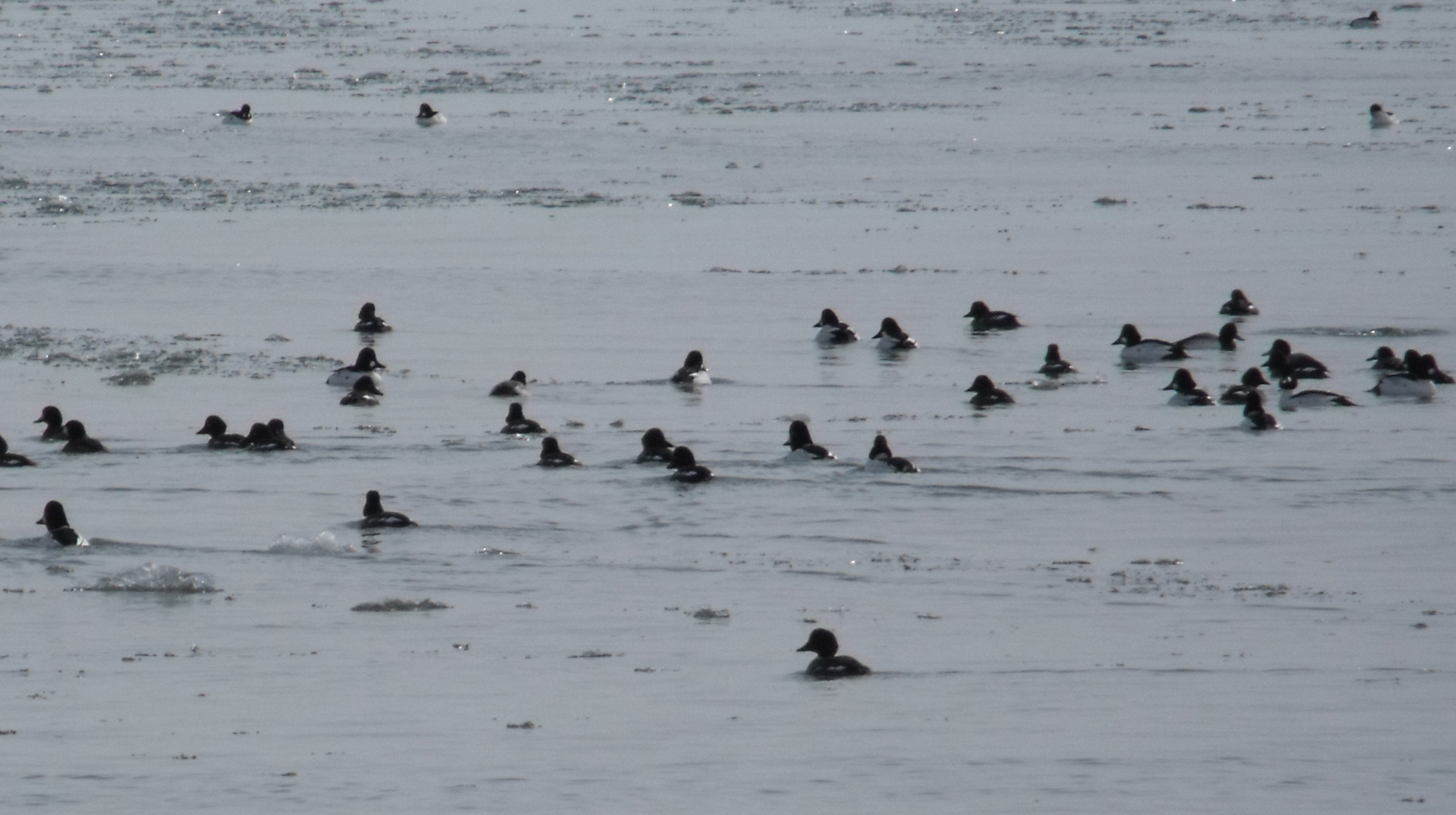
For the purposes of this blog - We (Barbara and I) did neither of the aforementioned.  We simply walked out - scared the ducks whipped out the binos for a quick peek and also took some long range images with the digital camera.  We did see a few of the Lake Park Birders standing about a 1/4 mile away on shore (in a little knot) for about 15 minutes before they apparently got tired of their extremely long-distance vantage point and left.  The surrounding ice-scape was quite spectacular in and of itself.  The waves of the big lake coupled withe the recent high winds had created these amazingly round ice globes in various sizes from an orange to a beach ball.  Walking amongst them created quite a challenge.  The threat level of slipping and twisting an ankle or bruising something important was high but well worth the journey.


Common goldeneyes, Hooded mergansers, Lesser scaups were numerous and quietly active. Even a sole pair of Mallards drifted by the iceberg we stood upon.  Ducks, ducks and more ducks dotted the light blue waterscape mixed in with floating chunks of frozen H2O.  Turning around, the city of Milwaukee glistened in the far off background as the sound of icy waters sloughed at the edges of the new Winter-created glacial shoreline.  Cars could be seen whisking their occupants north and south on Lakeshore Drive along with the occasional spandex-clad jogger - ponytail whipping like a pendulum clock.  February marches on and the citizens of Milwaukee marched too.


To experience such natural frigid beauty; one must purposely decide to leave the snugly confines of their artificially heated dwellings in order to bask in the genuine warmth of the sun.  It's tough fellow Midwesterners I know...but so worth the effort; bed sheet or not...just always remember your binoculars.


By the way...how DOES one get down off a duck?

Lesser scaups flying in formation

Got time for a peaceful moment? - Watch the gentle wave-action...


Ducks!


BIG Ice