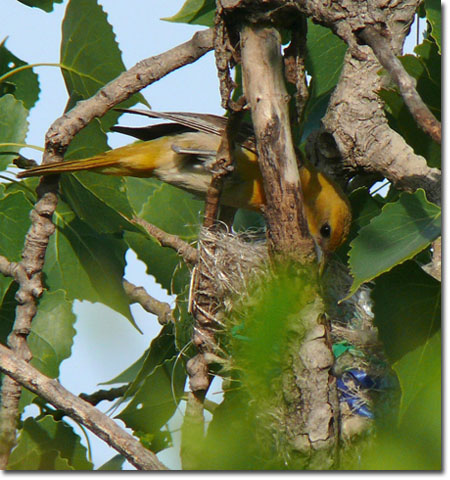
Showing posts with label Spring. Show all posts

Friday, March 26, 2010

Firsts of the New Spring (2010)

♫...Just around the river bend...waiting just around the river bend...♪

I look once more, just around the river bend of my favorite tiny stretch of the glorified drainage ditch that is the Menomonee River, to see what may be waiting...or is that "wading."  Sure enough, there they are; Mr. Mallard and his beautiful better half.  They're paddling ever so quietly, just at the edge of the undercut.  I stand there, motionless watching...just watching.  I am idly wondering how many people would even pause a moment to see what is a rather commonplace water bird, when behind me I hear, "Coming Through!"  I turn suddenly towards the interruption, to nearly be knocked into the drink by two of the BRAINDEAD.  Damn I hate that!  I'm telling you...what a totally ridiculous hobby to spoil a perfectly serene moment of natural commune.  Grrrrrrrrr...

I don't know what I have more of a problem with; the flamboyantly festooned cyclists bent on tear-assing up the nature trails, or the idiots who (like this other guy on my little first walk of the season) walk his German Sheppard off the leash, so that it's a full 25 yards ahead of him!  Shortly after the BRAINDEAD encounter, I am turned away from the thin path staring upward through my binoculars, minding my own business, when my peripheral vision catches the blur of fur on a bee-line towards me.  You guessed it...the guy's dog has damn-near scared the crap outta' me when I realize the size and breed approaching...no owner in sight.  Sheeesh!  That's unnerving I'll tell you.  I believe I uttered some sort of feral sound, as my brain attempted to catch up with my options.  Hey, buddy...you ever hear of a thing called a "leash law!"

Allow me a brief tutorial on the local Leash LAW!  Milwaukee City Charter Ordinance - Chapter 63-1. Definitions. In this chapter:  1. AT LARGE means an animal is off the premises of its owner and on any park or parkway without the permission of the department or the director. Any animal shall not be deemed to be at large if any one of the following conditions occurs: a. It is attached to a leash not more than 6 feet in length which is of sufficient strength to restrain the animal and the leash is held by a person competent to govern the animal and prevent it from annoying or worrying persons in the park or parkway.  Oh well...such was my first 1/2 hour back on my local birding trail. I can hardly wait for the brush to fill out so I can't see them coming even FARTHER away from me.

The Milwaukee County Grounds, another of my favs, yielded some more first of the year birds.  This area of Milwaukee County, referred to as the Detention Basin is truly "growing" in popularity for many marshland inhabitants.  This is the third spring for this recently completed dewatering project, and the surrounding fauna are taking hold nicely.  The late afternoon cold air is filled with the various sounds of life; Red-winged blackbirds, Song sparrows, Killdeer, American robins, and dogs barking.  Oh yeah, they're here too.  Bunches of them with their hands-off owners trailing way behind them, frolicking and biting at each other as they (gag-me) "socialize."  I just have to get over this, don't I?  Well...it's hard!  I am a law abiding citizen who follows society's rules; particularly when NOT following them, infringes directly on other people's nice days.  I promise...perhaps I'll try to turn even my other two cheeks, but it won't be easy...no sir.

Ok, back to the birding...perhaps I'll try it next time with a few cocktails in me, before I go out...just to mellow me out.  Care to join me?  Great, but leave your bicycle and dog at home thank you...♫ just around the river bend...♪ ♪

Saturday, February 27, 2010

Signs of Spring

We’ve all got certain ones that send the message.

Whether you live in the sunny climes of the south and west, or the frigid cold of the north and east; we all have our “seasons.” And with those changing seasons certain cues which herald them in. Some are quite obvious, yet most are subtle and quite personal. Think about what ushers the changes for you. Is it earlier/later sunrises, warmer/colder temperatures, or is it simply the TV program line-up? Perhaps you” know” it’s fall when football season begins, or spring when the talk is of March Madness. Since our seasons are truly climatologically anchored, it makes sense that the natural world often provides the many of these cues. For the purposes of this entry; let’s focus on spring. (…hey, it’s MY blog and I have a memory to share)

What is a “season” anyway? I found this very informative website HERE, if you want more a comprehensive study. However suffice it to say that the season of winter = slightly less than 89 days, and spring is about 92+3/4 days. Now that’s all relative to your geographical location, and mindset. If you are trapped in a basement office with no windows, for your work day (like I am) the comings and goings of Daylight Saving time compounding the effects of SAD; you scarcely see the sun anyway. So any chance you get to interact with the natural (outdoor) world is sacred – any sign of spring a blessed occasion. Come on Punxsutawney Phil…you can DO it!

To put you (dear reader) into the proper mindset, allow me to regale you with a collection of wintry regional, meteorological data. Wisconsin climate is typically continental with some modification by Lakes Michigan and Superior. The average annual temperature varies from 39 F in the north to about 50 F in the south. The lowest temperature on record was minus 55 F, reported from Couderay on both February 2 and February 4, 1996. During more than one-half of the winters, temperatures fall to minus 40 F or lower, and almost every winter temperatures of minus 30 or colder are reported from northern counties. The greatest August to July snowfall total for northern Wisconsin from the years 1908-2006, belongs to Lac Vieux Desert at 161.5 inches. Between March 4-5, 1976 – Wisconsin was hit with a devastating ice storm - One of the worst natural disasters to hit Wisconsin in history. This incredible ice storm completely snapped hundreds of utility poles, downed thousands of power and telephone lines and totally destroyed many trees. Some ice accumulations ranged up to a phenomenal five inches in diameter on wires and limbs of trees. The excessive ice accumulations were in part caused by thunderstorms that rapidly built up the ice. High winds gusting to 60 mph made a horrible situation even worse. Up to 600,000 residences were directly affected by the ice storm and up to 100,000 people were without power during the height of the storm. Some rural areas were without power for over 10 days. The following counties were declared federal disaster areas due to the ice storm: Calumet, Columbia, Crawford, Dane, Dodge, Fond du Lac, Grant, Green, Iowa, Jefferson, Lafayette, Manitowoc, Ozaukee, Richland, Rock, Sauk, Sheboygan, Vernon, Walworth, Washington and Waukesha.

In my immediate neck of the woods on March 2-4, 1881 there was a blizzard which dropped between 2 to 4 feet of snow. Drifts piled to 20 feet. Milwaukee reported 28.5 inches. Between February 24 and March 20, 1881, Milwaukee received 63.7 inches of snow! On February 4-5, 1924 another Blizzard gifted some 20.3 inches at Milwaukee / 10 foot drifts. This event still ranks as Milwaukee's heaviest snowfall in 24 hours. Between January 3-4, 1982, a blizzard of 8 to 16 inches pounded the northwest suburbs of Milwaukee had 16 inches. Madison reported 8 inches. December 14-15, 1987 a blizzard (gusts to 73 mph) - Madison and Milwaukee had 13 inches of snow….had enough? Let me tell you, by March 21st I have, and am eagerly looking for my own personal signs of spring…groundhog or no groundhog!

My mother and I shared a common sign of spring. When the robins could be seen and heard singing their “spring songs” it was very close - even if the calendar said otherwise. When I was in her zip code many years ago as a younger person, the first one to see and hear that wonderful harbinger would immediately alert the other. When I had later relocated some 225 miles southward, the same sure sign was relayed via telephone. Since my proximity to the equator was just that much more of an advantage; I would usually be the one to make that call. This always seemed to brighten her spirits and give her hope. For me, among other positive things, I could finally take the rope down from the garage rafters. (just kidding…but it surely felt like that)

Little did I know that in the spring of 2007, my phone call northward, cheerily announcing, “We’ve got robins Mom!” would have been my last opportunity; for on Groundhog Day 2008 (what irony) Mom passed away…taking any chance of spring with her for that year.

Yesterday, just after 6:00 AM as I was walking the snow-covered path from the grocery store near my home on a mission for a few things; it happened. My hands full of plastic bags, my step taking me back to the house, I trained my ear ahead to catch a faint and growing sound. Surely it was much too early?  I scanned the landscape for what I longed to see.  There, in the bare maple tree a bit farther up the street stood a single American Robin, singing…singing, and singing its Cheerily, cheeriup, cheerio, cheeriup song.  For some reason, hearing this magical (ordinary) sound on this cold February morning caused my heart to soar, and my eyes to weep; but it was time nonetheless. Without hesitation, I tilted my head upward and to the heavens above and emotionally whispered, “We’ve got robins Mom...we've got robins.”

I was (finally) spring.


Thursday, April 2, 2009

Spring Stimulus Package


Some stimuli are free and naturally occurring.

Let’s talk stimulating! Nesting time is just around the corner and in some areas, birds have already begun to do what comes naturally and begin. Most birds are not particularly fussy as to exactly where their incubation stations are located, as long as a few key features are present prior to site selection. Turdus Americanus (American Robin) fancies a variety of habitat including; Cities, villages, farmlands, gardens, and open woods. She will build her nest in shrub, tree fork, and horizontal branch or on almost any substantial ledge, principally on a house or outbuilding such as a garage, but rarely on the ground. How many of us can boast about the nest built over the outdoor front light fixture, causing us to cover our head each time we exit the house for fear of an agitated “mother” guarding her chicks. Birds will build their nests from grasses, twigs, sticks, mud and bits of string, plastic bags, and candy wrappers. You can even put colorful scraps of your leftover yarn and floss out in an empty onion bag for birds to find and utilize. Imagine the sight of a bird dwelling high in a tree festooned with brightly colored bits of your handi-crafts.

Birds can also be economical in their recycling techniques. For instance the Blue-gray Gnatcatcher will tear up a completed or partially completed nest and reuse the material to build another nest nearby. Most birds build a new nest each year. Some that have more than one brood in a season will build a nest for each brood. Other species, particularly birds of prey will often repair their nests from year to year and use them for many years in a row.

Why do birds build nests in the first place? Evolution is the simple answer. It is most widely believed that birds evolved from exothermal (cold-blooded) creatures into animals that could no longer abandon their eggs to hatch in the heat of their environment. As warm-blooded creatures, they were compelled to supply warmth for their eggs through incubation. This necessitated the development of protective measures not only for the exposed eggs, but for also for the parent bird. It is believed that nest building became a necessary part of the breeding cycle. The first nests evolved as well as the builders, growing from simple scrapes in the ground, and natural cavities in trees, etc. to the more complex structures we are familiar with today. Intricate camouflage is often interwoven into the exterior to match the surrounding limb or foliage, such as the Acadian Flycatcher, Eastern Wood Pewee or Baltimore Oriole do in the construction of their nests.

City birds such as House Sparrows will take advantage of nearly any man-made device or piece of equipment. While in Rhinelander, Wisconsin last weekend I spotted the clever use of the raised external letters on the side of the local Trig’s grocery store that spelled, “PHARMACY.” These sparrows were happy as a Lark as they sat in the Catbird’s seat watching the shoppers enter and exit the store. It didn’t hurt either that the supply of 50 lb. black oil sunflower seeds were stacked under the drive-through awning, not 20 feet away from these opportunistic survivors. Several bags had “mysteriously” been punctured and were providing the onlookers with occasional stolen moments of enjoyable dining. I even was fortunate to take a photo from the Davenport Street Bridge of a swimming Pine Marten (Fisher) as it crossed the river towards the Wausau paper mill. This is the same area where I will routinely see the year’s first Yellow-rumped Warblers on the banks of the Wisconsin. Rhinelander is the Home of the Hodag don’t cha’ know and the green creature of lore is the same one utilized by the high school as their official mascot, is painted on the sides of the police vehicles, and is also used by several businesses in the city in their names. By the way; Hodags (I’m told) don’t eat claw-fuls of these small migratory breeders, nor do they mess with the feisty Martens…just keep your white Bulldogs in your car with the windows up.

Sources: Hal H. Harrison’s Peterson Field Guides “Birds Nests” (and my fertile imagination.)

Thursday, March 12, 2009

March into Spring with Careful Observations

Just a bit of "featherly" advice: Never Assume

As the old adage goes when you "assume" you are making an ass of U and me. Just because you see that "LBB" (Little Brown Bird) on your wooden fence or lurking at the foot of your shrubbery, that "Oh...it's just another House Sparrow." You see at this time of the year in my neck of the woods, visitors begin to come knocking. Based upon the hand-written records we keep as a family inside the kitchen cupboard door from year to year, it's quite possible for migratory species to begin to investigate the corners of the yard starting now until early June. Those of you reading this (and I sincerely hope that more than I read it) in warmer climes, are no doubt chuckling the knowing titters of the privileged who always have a plethora of species at the whims of your binoculars. Well, I ask patience and understanding as I try to convey the sheer wonder and excitement of that first White-crowned or White-throated Sparrow of the year. I caution you (especially the "ho-hum" amongst you) to look carefully at that next bi-pedal leaf-scratching LBB in the yard as it just might be a Spotted Towhee instead of a run of the mill American Robin.

Have a trusty pair of mid range 8 X 35 binoculars sitting uncased on the closest windowsill and be ready to check out each movement. For this reason, I continue to fill the feeders until (at least) after the migration period hoping to coax a hungry traveler into range for a quick peek. Too bad I still have to go to work, or who knows how long I'd sit and watch. Keep a list of your own handy so that you can nearly predict which species will appear when. So far this year, the American Robins are 10 days earlier than last in Milwaukee and the Dark-eyed Juncos are still here. So the moral of this story is simple: Keep your eyes open, cause Mother Nature is a crafty one who can surprise even the most bored among us with her unpredictability.

Happy (early) Spring Birding Everyone!
* (Oh, and the LBB pictured above is a rare spring visitor to our yard, a Fox Sparrow)