In this edition of Birdstud’s Birdchat, we’ll be focusing on the birds of the Mississippi Flyway at Mid-August reverse-migration point of the year. We’ll also delve into some more small-town American (Wisconsin-style) moments as we do.
The trip from Milwaukee to Grant County, WI is about 3-1/2 hours at the maximum posted speed limits. I have found that I drive at the limits (watching everyone, and I mean everyone pass me up), because I am older, wiser and don’t want to have constant stress while I drive. You might imagine that I (driving the speed limit) might frustrate other zooming motorists who encounter me on the road, feeling the need for speed as they blast past, and you’d probably be correct. My response would have to be, “so what?” If you are one of these types of drivers; you get what you deserve in the racking up of multiple moving violations, dealing with fender benders, and the incredible non-stop mental angst you put yourself through. But then, I digress…
 Our target for the weekend was indeed an incredibly wide and serene section of the Mississippi River adjacent to the US Army Corps ofEngineer’s Grant River Campground, but there were also a few other stops we planned to make in the area before the weekend was over. Long ago glaciers advanced and retreated across Wisconsin, with the last retreat about 12,500 years ago. The southwestern corner however, was untouched and is known as the "driftless" area or Paleozoic Plateau. It is a land of deep valleys, ridges, and bluffs never leveled by the glaciers. The campground (off Hwy 133) is nestled between a vast stretch of the big river and the tiny “Catfish Capital of Wisconsin”; Potosi. Nicholas Perrot discovered southwestern Wisconsin's first lead mine in what is now Potosi. By 1850, the area embraced more than 10,000 hand-dug lead mines, supplying more than half of the nation's supply. Mississippi riverboats carried Wisconsin lead throughout the nation. The region produced virtually all of the lead shot for the Northern forces during the Civil War. One more interesting feature that we soon discovered was also in between the river and Potosi, were two long shiny railroad tracks running right next to the tent campsite I had booked unseen on the Internet.
The 56 other reservable electric sites were all in use with large and impressive (hard-sided) RV units. We later learned that a strong contingent of Good Sam campers from neighboring Iowa had all decided that this weekend was their chance to get together in Wisconsin. They were incredibly organized and had a multitude of activities planned all weekend for their (mostly) aged members to enjoy. One such delightful couple was Bob and Kathy Michael, (from Dubuque) who took up residence adjacent to our track-side site in their (home away from home) pull-behind “hybrid” camper. At one point Kathy brought over to share; the most wonderful homemade molasses cookies I had ever eaten. Once our site was set - complete with tent and sleeping gear and the majority of other (brought-along) items were in place; we motored off to nearby Lancaster, WI and the Grant County Fair.
 The fair was located off a non-descript side road from the main highway that split the town of Lancaster. We only found it because I am unopposed to asking directions. I had driven about as far in and out of the town as I dared without seeing the fairgrounds when (at the northern edge of the city) I spotted a large Pamida (next to Gassers True Value hardware – imagine the sad and endless childhood taunting of the little Gassers in elementary school). I drove up to an elderly man, circling his pick-up truck in the parking lot on foot. He was wearing a GB Packers shirt and using a cell phone. The two even older white-haired female passengers in his vehicle quickly deferred to his cartographic prowess when we asked where the fair could be located. He came around to my side of the car and said the following, “you know back the way ya came, where the road kinda’ dips down…you know, then where the road takes a jog…well, the road you want is right there across from the library.” Barbara and I smiled at each other and bid him and his equally smiling passenger’s goodbye, and headed off to the only landmark in his rambling directions that made us certain we’d eventually find it – the library.
After the car was parked in the field earmarked with a hand-painted sign indicating which aisle we had self-parked into, we walked past the wooden sandwich board indicating that an “adult season pass” to the fair was seven dollars. We then halted our advance opposite two elderly VFW-garbed men with a huge roll of entry tickets. “Day or season?” enquired the nearest one, extending the ticket roll. Since I could find no handy reference whatsoever to any other admission choice or price, I opted for two “season” passes, citing the (what the heck, slim to none) possibility that “we could come back on another day.” The surrounding grounds were filled with smiling adults, children and entire families as we worked our way around the perimeter of the fair; past the sprawling antique tractor collector and Platteville Optimist booths. It was going on 6:30 PM and we were both wanting to learn the details of the advertised 7:00 PM Tri-State Truck and Tractor Pull and to get something to eat before the big event. We headed for a huge grandstand-looking building with our questions and our appetites.

People seemed to be standing at a small table near the backside of the stands, receiving a paper wristband in exchange for a business card slip of paper. I found out that this was the “Fair Bonus Card” redemption center and if we had been savvy enough to pre-purchase one; we’d have received “deep discounts” on all purchased beverages and food. Since we had not, we shuffled away to a tall painted plywood kiosk under the stands that was selling beer “tickets” (one for $ 2.50/ two for $ 5.00). A man and woman were both wedged into the small booth. The man leaned toward the window ledge as I approached to ask what purchasing the tickets meant to me. “It’s for the beer” remarked the jug-eared bespectacled, string bean man. He was wearing one of those old-time red and white striped aprons. My second question of “is a beer one or two tickets?” caused him to look backward to the woman as if to ask her if I was for real. He looked back and grinned, “one beer for one ticket.” Wow, I thought and said as much to Barbara. This was great! Being accustomed to paying over six dollars at any number of venues in the greater Milwaukee area for a 12 ounce cup of adult malt beverage, I was elated. “I’ll take two (for now”) I said with real joy in my heart.

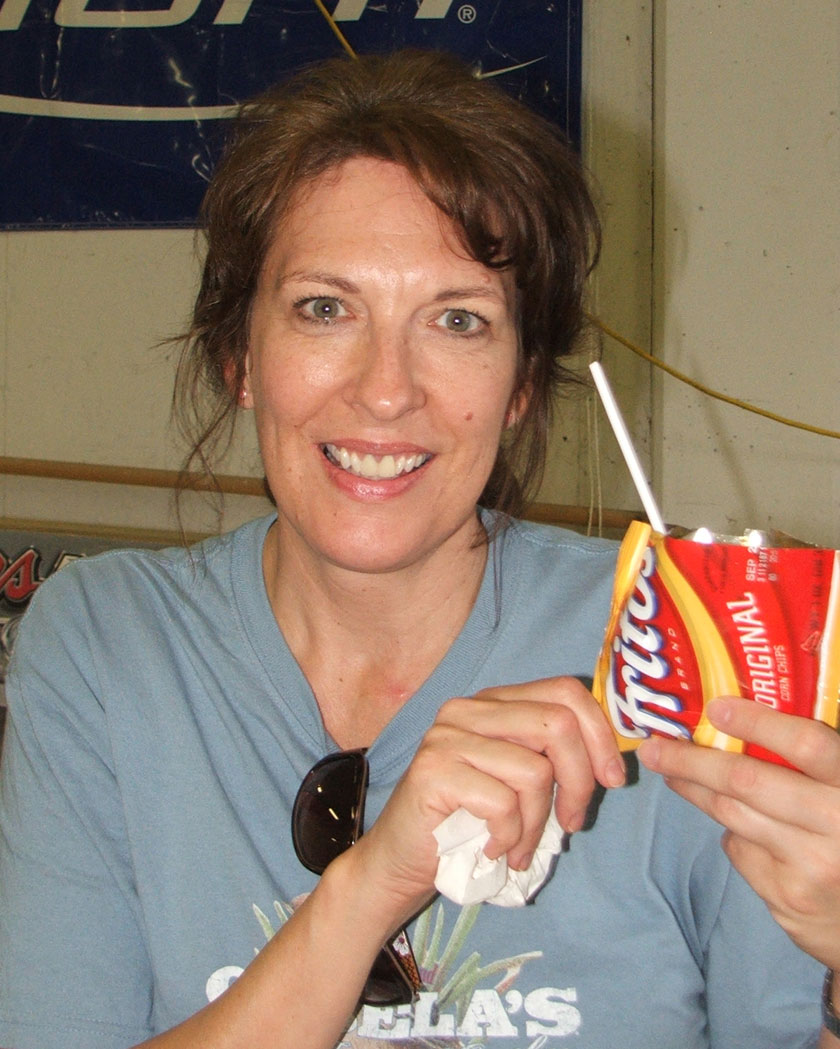
After waxing a lengthy Lions Club conversation with the Lancaster Lions members who staffed the beer ticket redemption counter, we got in the queue for the homemade foods. A pork loin sandwich was recommended for me by one of the volunteer grillers and Barbara decided on the “Walking Taco” (A neatly snipped bag of Fritos as the main course, covered with taco meat, cheese, diced tomatoes and shredded lettuce.) We ate at a wooden picnic table under the grandstand with a large cow-barn fan pushing natural coolness onto the bystanders; thoroughly enjoying the local fare. I then wandered over to the ticket window and bought a pair of general admission tickets to the truck and tractor pull for another 14 bucks; plus two more beer tickets later and we were sitting on the aluminum bleacher seats awaiting the next exciting participant in the contest. From the eyes of a complete novice; the Tri-State Truck and Tractor Pullers run a nice, neat, tight competition. Mod 2wd Trucks, Modified V8 Trucks, Hot Farm Tractors, Super Farm Tractors, Super Stock/Pro Stock, Tractors, and the ever popular 2011 SUPER STOCK 4X4s make up the six categories of sliding weight-pulling vehicle. The membership entry fee to the Tri-State club (allowing the members to participate in multiple annual contests) is $100.00 per vehicle (tractor or truck) and $25.00 for each driver to cover insurance. Each puller is allowed two attempts to make a measurable pull within 100 feet. Moving the sled a measurable distance (one inch or farther) is an attempt. Weights pulled, range from 6000 to over 10,000 lbs!

You’ll be happy to know (as I certainly was) that (according to the 69 official general rules) “when a vehicle motor is running someone must be in the driver’s seat at all times in the pits or on the track,” and that “no shorts are allowed during pulling or while working as an official.” When one unlucky puller got off to a great start and suddenly blew something up inside his rig, the sage and wizened track announcer stated the following for the benefit of the assembled crowd of anxious onlookers; “You know these tractors are pushed far harder than God ever intended them to be sometimes.” Amen brother.
The 30-minute ride back to the Grant River Campground was uneventful. We climbed into the small nylon tent to collect some blissful shut-eye when the first of the eight, nightly speeding Burlington Northern Santa Fe (BNSF) freight trains, suddenly slammed onto the tranquil scene. Our campsite was strategically layed out midway between two (mandatory 140 decibel, locomotive horn-blaring) crossroads. We were particularly ensured to hear both engineer-delivered warning blasts with equanimity. The brain does crazy things when the lights are out and imagining that the incredible cacophonous racket caused by the passing train cars would evolve into a screeching, twisting, accordion wreck of massive landscape-flattening freight cars is an easy one. The BNSF (formed in 1996 out of the merger of the Burlington Northern and Santa Fe railways) is the second largest freight railroad in America, and is based out of Fort Worth, Texas. BNSF directly owns and operates over 24,000 miles of track, in 27 states, hauling primarily grain, coal and intermodal freight. These fascinating BNSF details were unfortunately lost on the both of us in the middle of the night while fighting to stay asleep between repeat performances. Oh, and it rained too. Hard.

Bird watching the next morning was wonderfully diverse. While the coffee perked on the old green E-Bay Coleman stove; bright orange and black Baltimore orioles sat singing on an overhead electrical wire. A large group of Red-winged blackbirds gathered in a nearby tree to verbally strategize their day as (over twenty) Turkey vultures soared in low trajectory arcs over the dual train tracks. Cicadas were just warming up to their full pitch when the morning sun began to dry the moisture from the green tent and red bag chairs. Many other birds could be seen and heard within the campground confines. The list we tallied includes: Indigo bunting, Northern cardinal, Black-capped chickadee, American goldfinch, American robin, European starling, House finch, House sparrow, Downy woodpecker, Eastern wood pewee, Gray catbird, Chipping sparrow, White-breasted nuthatch, Field sparrow, Tree swallow, Barn swallow, Chimney swift, Mourning dove, American crow, Cedar waxwing, Least flycatcher, Great crested flycatcher, Eastern kingbird, Tundra swan, Great blue heron, Solitary sandpiper, Blue-winged teal, Ring-billed gull, American pelican, and Belted kingfisher.

The surrounding farmland was planted and thriving with eight-foot tall corn and acres of soybean plants. The entire area along the Mississippi basin seemed lush and green; apparently plenty of rain had fallen in this year’s growing season. We put the Canoe-dle in at the handy concrete campground landing in the early evening, to partially escape being broiled within the shiny watercraft. Light intermittent rain showers caused us to head for the shelter of overhanging trees near the northeast bank on several occasions, but the two hours we spent slowly paddling and exploring were relaxingly splendid. Lilly pads along the sides of the river were huge and plentiful. Duck weed covered the surface of the still near-shore water with a speckled brilliant green. Large Catfish and other unknown shallow water creatures stirred the muddy river bottom as our aluminum canoe passed them overhead.

All in all, the trip was satisfying on many levels. The camping, biking, and canoeing each complimented the surrounding beauty of the countryside, and even the noise of the trains was a unique opportunity to study the strength of American rail commerce. We included a delightful Potosi Brewery tour and beer-drinking experience as part of this trip; however it will be detailed in another blog installation at another time. This one’s getting long and I’m sure you need to take a break now. Thanks for reading and (hopefully) enjoying the journey along with us, at this little slice of the Wisconsin bank of the Mighty Mississippi!


 The entertaining feathered activity around the campsite continued off and on throughout the entire glorious day. A crazy looking Northern cardinal with most of its head feathers missing would show up and take a few seeds, along with a (quite normal-looking) female. Barbara and I speculated aloud as to that peculiar relationship. Perhaps it was some sort of Phantom of the Avian Opera attraction? A thirteen-lined ground squirrel ran in fast and low to the ground filling up its cheek pouch several times; taking the moist oral stash back to its burrow about 15 yards away. Chipping sparrows and the occasional junco would join the others, but weren't interested in the sunflower seed like the nuthatches were. The sun continued to shine through the pines and kept the air at a perfect temperature as we sat and relaxed; watching the free nature show. An Eastern towhee crept out of the leaf litter it had been foraging through to investigate the seed piles, but didn't stay long before retreating once more to the security of the underbrush.