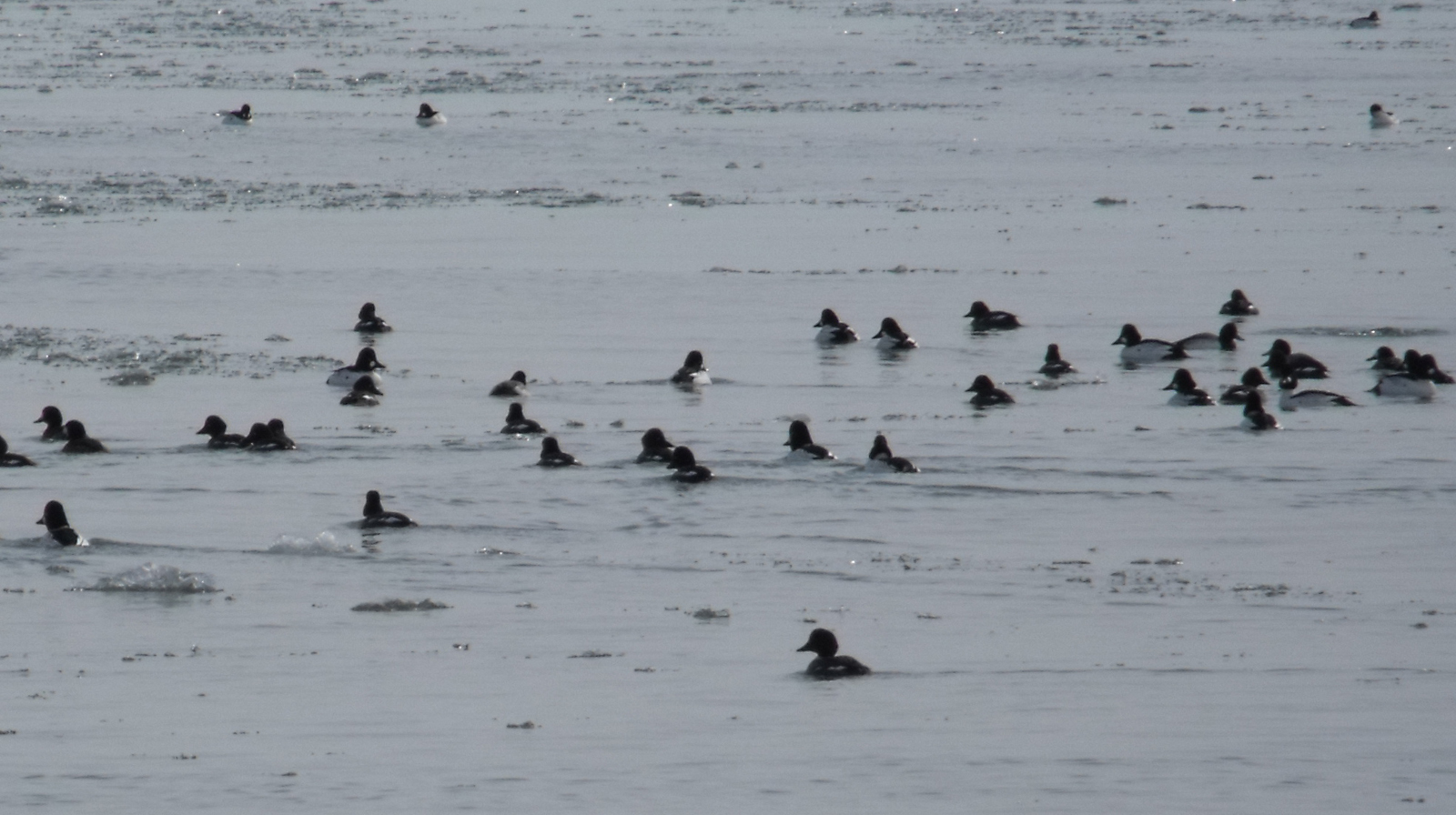
On a sub-zero day in January 2015, I drove the WPT east to the shores of bone-chilling Lake Michigan to see just what ducks were there. It was overcast, gray and windy as I pulled up in the parking lot of the water station and strapped on my gear. I was dressed in layers to help fight the cold, but my hands were having a tough time with the gloves I had chosen. Mittens would have been smarter; but using a camera with no finger dexterity is difficult. I waded through a freshly falled amount of powder and approached the lake. Ice had formed to within 10 yards of the shore in chaotically layered islands. A slow but determined wave motion sloshed up into small "bays" and cuts in the ice pack. I needed to be extremely careful not to slip; but even more wary not to blunder into a disguised mini-gorge and into the ice water. There was virtually no one who would ever hear any pleas for help. The only other person I saw was one of those psycho-runners tip-toeing on the icy public sidewalk near Lakeshore Drive...and I thought I was nuts.
Ooh boy it's cold!
The predominant avian form seen this day was the Common goldeneye. 1. "Among Common Goldeneyes pair formation begins in midwinter, and until then the two sexes often form separate flocks. Indeed, males winter farther north than do the females. During its courtship display, the male stretches his head forward along the water and then snaps it rapidly upward over his back, bill pointed skyward, while uttering a shrill, two-noted call. Then he swings his orange feet forward, sending up a small shower in front of him. The wings of this species produce a loud whistling sound in flight, easily identified even when the birds cannot be seen; hunters call this species the "Whistler." Goldeneyes can dive to depths of 20 feet (6 meters) or more, but generally limit themselves to about 10 feet (3 meters). In winter, goldeneyes feed mainly on mollusks; in summer, their diet shifts to aquatic plants and insects.
Common Goldeneye
This species is particularly hardy and often the last waterfowl species to leave the breeding grounds and the first to return. Migration peaks occur in November and March/April. The species migrates in small, loose flocks, concentrating at suitable stopover points, especially in spring when these are limited. River valleys tend to funnel inland migrants to some extent. All populations are migratory, even where the species occurs year-round. Individuals may migrate only as far as necessary to find open water. The winter range is contiguous with the breeding range except in south-coastal Alaska and extends from the Alaska Peninsula along the Pacific coast to southern British Columbia, then across southern Canada and the lower 48 (except inland southern areas and south Florida) into coastal and lowland northern Mexico. Adult males tend to remain farther north than adult females, which in turn remain north of juveniles. The species also breeds across northern Eurasia and winters south to the Mediterranean, Caspian Sea, and Japan."
Lake Michigan shoreline in January
1. Source: Boreal Birds.com about the Common Goldeneye
The Mallard didn't have any money for the lip balm; so he told his pharmacist to "put it on my bill" - quack!
Milwaukee, Wisconsin in February
What else is there to do on a cold (but warming slightly) Milwaukee, Wisconsin weekend right?
Why go and watch the ducks on the lakefront - of course. The only problem with doing so is being able to actually "see" them. To make it happen, you either have to have a HUGE spotting scope and tripod coupled with patience OR I would think a queen-sized bed sheet could do the trick. What I mean is (for the latter idea); dress warmly, carry your binoculars and sneak out to the edge of the ice flow, sit down on a chunk of Styrofoam, drape the sheet (plain white of course) over yourself and wait. Congratulations; you have just successfully camouflaged yourself as a drift. You'll have to "wait" however because all the while you are sneaking, the ducks will have noticed the movement (no matter how stealthy) and have slowly swam farther out to sea en-masse. It'll get damn cold as you wait for the ducks (if they ever do) to decide that whatever dragged itself out on to that far away ice shelf is no longer a threat; mysteriously disappearing into the landscape.
For the purposes of this blog - We (Barbara and I) did neither of the aforementioned. We simply walked out - scared the ducks whipped out the binos for a quick peek and also took some long range images with the digital camera. We did see a few of the Lake Park Birders standing about a 1/4 mile away on shore (in a little knot) for about 15 minutes before they apparently got tired of their extremely long-distance vantage point and left. The surrounding ice-scape was quite spectacular in and of itself. The waves of the big lake coupled withe the recent high winds had created these amazingly round ice globes in various sizes from an orange to a beach ball. Walking amongst them created quite a challenge. The threat level of slipping and twisting an ankle or bruising something important was high but well worth the journey.
Common goldeneyes, Hooded mergansers, Lesser scaups were numerous and quietly active. Even a sole pair of Mallards drifted by the iceberg we stood upon. Ducks, ducks and more ducks dotted the light blue waterscape mixed in with floating chunks of frozen H2O. Turning around, the city of Milwaukee glistened in the far off background as the sound of icy waters sloughed at the edges of the new Winter-created glacial shoreline. Cars could be seen whisking their occupants north and south on Lakeshore Drive along with the occasional spandex-clad jogger - ponytail whipping like a pendulum clock. February marches on and the citizens of Milwaukee marched too.
To experience such natural frigid beauty; one must purposely decide to leave the snugly confines of their artificially heated dwellings in order to bask in the genuine warmth of the sun. It's tough fellow Midwesterners I know...but so worth the effort; bed sheet or not...just always remember your binoculars.
By the way...how DOES one get down off a duck?
Lesser scaups flying in formation
Got time for a peaceful moment? - Watch the gentle wave-action...