Showing posts with label Cannon Beach. Show all posts

Sunday, February 12, 2012

The Great Northwest Birding Adventure of 2011 (part two)

Western Gull - Pet?
The Ester Lee Motel is a classic gem standing proudly on the rocky bluff next to route 101, in the bucolic and friendly Oceanside community of Lincoln City, OR.   Lisa (my sister) and her significant other “Shaun” had graciously rented a surprise cottage for the evening.  Cottage number 229 was completely wonderful, and cozy!  The view (“Ahh, what you can see from the Ester Lee!”) was magnificent and the cabin-like accommodations splendid.  Once the overnight gear was stowed in the building, we jumped back in the car and drove a little ways south into the serene village.  We parked in the public lot at the end of SW 51st street just down from MO’S where we would all later dine on delicious MO’s creations such as their famous “Slumgullion” chowder in a “cannonball (bread) bowl”.

California Sea Lions
Before we sat down to dine, we walked the rugged public beach area as an intermittent, light, but cool rain fell.  Fortunately this combination of setting sun and falling water droplets created a beautiful rainbow to the east.  The narrow water channel we walked alongside provided a curious view of the bank opposite us, as a multitude of California sea lions lay piled up near the water’s edge.  They were safely out of harm’s way and seemed happily ensconced in the moist sand.  Male California sea lions are dark grayish or chocolate brown, while females are lighter brown. Newborn pups are dark chocolate brown to black and weigh about 13 pounds. Male California sea lions are much larger than females, weighing as much as 1,000 pounds, and measuring up to 8.2 feet long. Females weigh up to 250 pounds and reach lengths of up to 6.6 feet.

Crack that whip!
Odd looking strands of rope-like structures with bulbous ends were strewn here and there on our side of the channel.  Shaun noted that these were pieces of tidal-deposited “Bull Kelp” as they resembled a giant length of bull whip.  Nereocytis luetkeana kelp – (AKA: edible kelp, bull kelp, bullwhip kelp, ribbon kelp, giant kelp, and bladder wrack) is the Greek word for Mermaid’s Bladder and can grow in lengths up to 74 meters.  The specimens that had washed up here were considerably shorter and could in fact be wielded like a whip.  Like all novice whip-wielders may admit, trying it for the first time, ain’t necessarily all its “cracked” up to be.  I say this, because I was not the only one to give it a mighty flip; only to be struck somewhere on my own body hard enough to cause real physical pain.  Polly the toy poodle, wearing a doggy-sized camouflage coat; rambled back and forth along the beach in frantic zig-zag fashion, sniffing and snuffling.  The sun began to set as the six of us took pictures and turns looking through our binoculars at the bird-life this section of coastal  landscape had to offer.

Pelagic Cormorants
The next morning Barbara, Anna, Polly and I walked down the paved road from 229 to the beach below the Ester Lee.  Polly couldn't behave herself and kept on barking to the point where a nearby private residence opened its door to emit a cranky foul-mouthed Lincoln City resident who was displeased with the early morning nuisance.  Poor Anna took the brunt of this guy's unhinged ire as she had been chasing the damn dog all over in order to get it to shut up.  Barbara and I walked the beach, looking at the rocks and wood that littered the tidal zone.  There were no beautiful shells of any kind to be found here...just rocks and mussels.  After a shower and a leisurely conversation in the cottage's living room, we packed up the vehicle and checked out.  We visited the towns of Gleneden Beach, Lincoln Beach, Depoe Bay, Otter Rock, Beverly Beach, Agate Beach and as far south as Newport, OR.  A high bridge took us to the southern end of the city to our chosen destination.  The birding was tremendous along the long man-made length of sand-filled concrete bulwark that was at the end of SW 26th Street.  The twin jetties basically formed a safe and calmer sea inlet to the city proper.  It was along this wall that I would score my first Pelagic and Brant's cormorant, male Harlequin duck, Black oyster-catcher and Surf Scoters! Brown pelicans and Double-crested cormorants hung out together on the rock outcroppings, as orange starfish clung to the submerged rocks just at the surf line.

Coast Guard training at DePoe Bay
Heading back north on the way back to Silverton, we stopped again at Depoe Bay as it had stopped raining for 5 minutes...Ok...well maybe it was 10...to look again at the scenery from outside the car.  The town (officially formed in 1927) was named after a local resident, Charlie DePoe, a Joshua Indian who settled in that area in 1894. It was in this general area that I also recorded another life-bird...the Heerman's gull.  A rocky projection in the distance; made up of volcanic spew, was the current fishing grounds to dozens of Brown pelicans, Western gulls and other smaller shorebirds.  The Heerman's were huddled on the nearer sand beach in a small knot, facing the waves.  The Heerman's Gull is the size of a Ring-billed Gull, but stockier. It is unique in that its plumage is mostly dark. The Heerman's Gull has a dark gray back and wings with a lighter gray body. The head is white with a black-tipped red bill and a dark eye. The tail is black with a white terminal band. The wing has a white trailing edge and black tips. Some individuals have a white patch at the wrist. The feet are black.  A Pacific species, the Heerman's Gull nests in western Mexico, and spends the non-breeding season in marine areas. A variety of coastal habitats, including rocky shores, bays, small offshore islands, kelp beds, sandy beaches, and estuaries, are all potential roosting sites. They seldom spend time at garbage dumps or on fresh water. It was rainy and a strong cool wind was blowing so we couldn't spend much time observing them, however the sight was unforgettable for a birder.
Heerman's Gulls

The next day (November 8th, 2011) Barbara and I were on our own as our hosts needed to go to work and school, so armed with handy suggestions of where to find birds; off we went to find adventure.  Our first stop of the day was the "bird go round" near Keizer, OR. which was technically a sewage water treatment plant for the City of Salem...but we didn't hear that bit of detail from Lisa.  We drove to the area she had indicated on a hand-drawn map and discovered a small wetlands area that was created by the sanitation district as a "natural" area of ecological renewal - wetlands restoration.  After walking the gravel paths that wound their way around four ponds, seeing a decent amount of waterbird-life; we spied two structures through the chain-link fencing that partitioned off the natural area.  Yes indeed these appeared to be round, and sure enough there were birds flying and some that had landed on the structural members that were slowly rotating, stirring up the good citizens of Salem's wastewater into something recyclable.  It dawned on me what my creative sister had been referring to when she suggested we bird here.  The cool of the surrounding air meeting with the warmth of the poo-water created a curious fog that arose from the slowly revolving gull carousel.  All that was missing was some calliope music and the glorious oily-scent of Pronto Pups.  We recorded many Golden-crowned kinglets, Starlings, Coots, Mallards, Green-winged teal, Black-capped chickadee and one Kestrel.
Watch for more!

The next stop on our solo-tour was Silver Falls State Park...in my next installment.

Sunday, November 20, 2011

The Great Northwest Birding Adventure of 2011 (part one)

This series of Birdstud’s Birdchat focuses on the birds (and life) along the Oregon Coast.  To the locals it’s the “Orgun” coast and to me it was “Or-e-GONE” until I was corrected enough to have it sink in my Midwestern bird brain. 

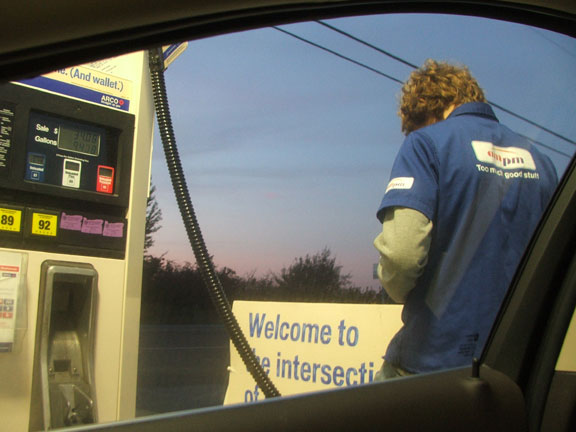
Funny thing about being in Orgun; you can’t pump your own gasoline.  It’s true…you pull up to the pump and roll down the window and “order” your gas from a person in a reflective vest.  EVERY person has to do it that way – even if you are in a hurry.  I embarrassingly discovered an important ritual after my tank had been filled and the kid walked off as I sat quietly in the rental car for about seven minutes waiting for the attendant to return to my window to swipe my card.  There I sat, and sat, watching people walking back and forth into the building, other cars arriving - being filled and finally the kid yells to me across the tarmac as I stupidly sat there, “You gotta go IN and pay!” You see, they accept cash from the car window, but if you say to “fill it” on a “debit” (only) card, you have to get out and go inside, to pay it yourself.  That’s some kind of union, I thought. There’s no state sales tax on goods, so that’s nice, however the price of gasoline was 60 cents per gallon more expensive than in Wisconsin where people are smart enough to fill their own automobile fuel tanks and lawn mower gas cans.  You might be waxing historical quaint visions through your head (if you’re old enough) about “full” service provided by gas stations of yore – don’t.  All you get for the extra 60 cents per gallon is the nozzle in your filler throat…that’s it.  No clean windshield, no offer to top off your fluids, check your oil, or wipe the bugs from your grille…nothing.

The same union (in league with the ferryman’s union) is no doubt in charge of deciding new bridge construction projects.  I have determined this because of the lack of bridges across the Willamette River near their capital city of Salem.  There’s one (way) south and one (way) north of the city and in the middle – ferries.   By the way, it’s Will-AH-met, not Will-a-MET.  And by the way, Oregonians who don’t quite hear what you said and wish you’d repeat yourself will say to you, “do what?”   Another regional lesson learned was that if something was expensive (like the $ 3.79/ga gasoline) it’s considered “spendy.”  Except the locals didn’t bitch about the price of gas or the fact that they are banned from using the gas pump dispenser, or the missing bridges…that was me.  Other than that Mrs. Lincoln, how did you enjoy the play?


Truthfully, the entire wilderness coastal area was wonderfully bucolic in an extremely humidified way.   I have never seen so much moss.  North side, south, east and west side of every tree in the forest.  Get lost in these woods – good luck.  Talk about BIG trees!  I’ve not yet seen the Redwoods of northern CA. however these massive trunks would give most of them a run for their money, in the girth department.  As such, the woods were temporary home to many of the birds that had already left Milwaukee in mid-September. 

In the Baskett Slough National Wildlife Refuge I chocked up a new (life) bird, the Bewick’s Wren.  Other birds of that damp and green area were Stellar’s Jays, Yellow-rumped warblers, Brown creepers, Black-capped chickadees, Red-breasted nuthatches, Red-shafted Northern flickers, Hairy and downy woodpeckers, American crows, Common Ravens, Spotted towhees, and the (ever-popular) American robin.

Stopping the car along the road into the slough next to open water, countless geese were swimming.  There are numerous subspecies of Canada geese and now, even 2 separate species (2004). What was once considered the Canada goose has now been divided into 2 species: the Canada goose and Cackling (Branta hutchinsii) goose.  There are 7 subspecies of Canada goose, and 4 subspecies of cackling goose. Each subspecies is somewhat distinct in appearance and migration patterns. All look more or less like the Canada goose familiar to us all: brown body feathers, a black neck and head, and white cheek patch. However, size among subspecies can vary greatly, and markings can vary subtly.   The two species were represented here in tremendous numbers: Canada and Cackling, with Cackling far outnumbering their larger (deeper voiced) relatives.  As well as being much smaller; Cackling Geese also tend to have rounder heads, and shorter, stubbier bills than Canada Geese. Cackling Geese generally have a more rapid and higher pitched, or "cackling" call which was quite discernable when a flock was flying over.  Maybe it was me, but I could notice that the flocks of Cacklers were nowhere as uniformly “V” looking as the Canada flocks I am familiar with.


Fall birding in the Willamette Valley presented a unique chance to view one of the subspecies of Canada goose; the Dusky goose.  The dusky is a subspecies of Canada goose that breeds only in the Copper River Delta area on the south-central coast of Alaska and on islands in the Prince William Sound and Gulf of Alaska.  They winter primarily in the Willamette Valley and along the lower Columbia River of Oregon and Washington.  The dusky has one of the smallest populations of geese in North America and were in small numbers when I saw them on the banks of the Columbia River, near Portland.  Here they feed on nutrient-rich grasses that grow in the wet, mild winters until they depart in early April.  In the late 1950s, managers recognized that wintering habitat for duskies was limited and hunting needed to be restricted to protect duskies.  At that time, duskies made up about 2/3 of the geese in the Willamette Valley, and it was recognized that the area was essential to their winter survival.  The dusky is a medium to large, dark subspecies of Canada goose.  They have darker backs and breasts compared to other subspecies in this area.  Some duskies may be wearing red neck collars with white letters.  Duskies are often found in small groups by themselves or mixed with other subspecies.

A surprise stop along the Salmon River in the tiny village of Otis, Oregon was almost worth the entire trip.  Here in a nondescript series of buildings, sandwiched between some foothills and the highway is the one and only Salmon River Pronto Pup!  When it comes to authentic golden deep-fried crunchy corn goodness; nothing beats 'em.  This fine dining establishment has been handing oil-dipped, cornmeal-coated tubes of assorted organ meats across its weathered, laminated counter, to eager customers since 1946.  I stood mesmerized, watching from the outside through a strategically placed window into the actual kitchen area where the magic happens. I gasped as it dawned on me the secret to making a perfect Pronto Pup; wipe your weenie dry with a rag first, before dipping it. 

I recall when I attended Catholic school in Coon Rapids, Mn. that the lunch menu often had these delicasies as the main dish.  I remember it because I wasn't sophisticated enough to have heard the true name for the lowly "corn dog" I had been previously familiar with as an elementary schooler from Madison, WI. until then and the moniker always stuck with me.  I often wondered through the years where the name had come from.  I suppose it rolled off the tongue more smoothly than would say, "Fast Dog" and so now here I was 40 years later again (way) west of the Mississippi (where they've never heard of a bubbler), staring at a blast from my past.  I almost had to blink twice when I read the large menu sign over the counter.  Hey, you can get six regular pups for 12 bucks!  Lisa ordered up and paid for all of us.  Plus, she threw in an order of the homemade sweet potato fries - the best I have ever eaten; hands down.  The disclaimer sign above the counter reminds the wary health conscious among us that the pups are, "Healthy We Cook In Trans Fat Free Oil,' for goodness sake. 

The small dining area reeked pleasantly of hot oil as the six of us sat munching our piping pups.  As I am prone to doing; I looked around at the various merchandise items for sale.  One wall had the obligatory display of restaurant-fan tee shirts but also harbored a unique twist; the actual, sacred, original formula, Pronto Pup mix! I looked at the sign that advertised the five pound bag for 15 bucks and hestiated only slightly before discovering that not only one, but TWO free additional packages of the authentic pup "sticks" went along with the deal.  SCORE!  Of course I bought both the bright yellow tee shirt and the mix (with free sticks included) in a heartbeat.  I mean c'mon...who wouldn't right? Granted, I have known for some time that it doesn't take all that much to impress me, or make me want to pump my fist into the air with delight.  However, that was clearly one of those moments.  I make no apology.

With the day moving along towards afternoon, it was time to move further west toward the actual Orgun coast.  We all carefully shoe-horned ourselves into the Mazda along with Polly the toy poodle, and happily belched our way towards Lincoln City and the waiting Esther Lee Motel...more to come!


Resources: